

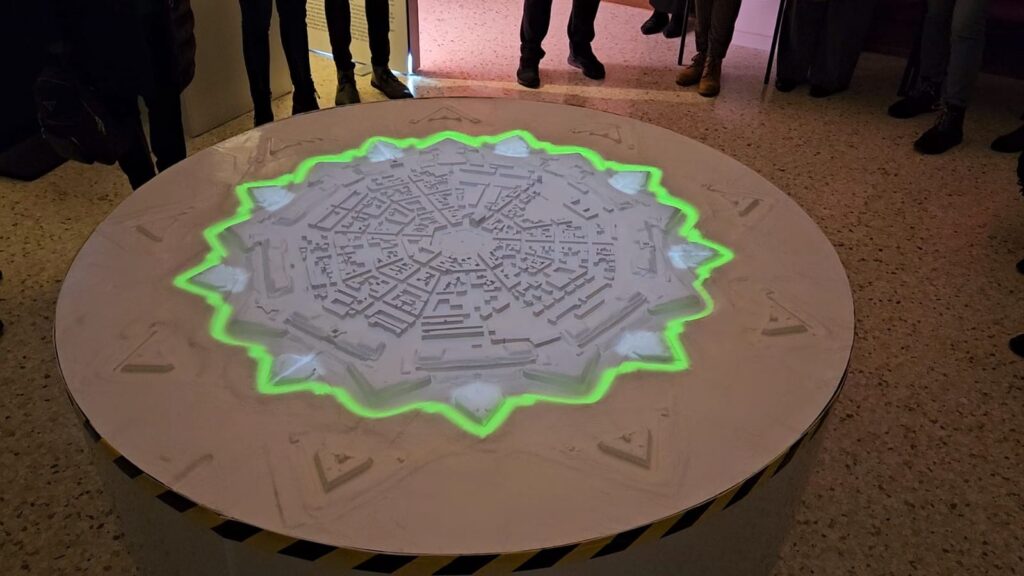
The Multimedia Video Room offers an immersive experience designed to help visitors discover the history of Palmanova in an engaging and accessible way. Through a 3D videomapping projection of the Fortress, video installations and virtual narrators, visitors can explore the four main historical phases of the fortress-city: from its foundation during the Serenissima Republic of Venice, through the Napoleonic era, the World Wars and finally present-day UNESCO-listed Palmanova.
Historical characters and interactive contents accompany the narration, making the visit dynamic and accessible to everyone. It is the ideal introduction for understanding the structure and historical evolution of Palmanova.
Inside the Multimedia Video Room, visitors will find a 3D videomapping projection displayed on a 1:1000 scale 3D-printed model of the Fortress, four virtual narrators and five video projections that create a journey through the places, people and historical events that shaped the evolution of the Fortress City of Palmanova.
The experience explains the reasons that led the Serenissima Republic of Venice to found the city in 1593, continues through the French domination under Napoleon Bonaparte — who visited Palmanova twice and expanded its fortifications — and then retraces the Austro-Hungarian period, the Risorgimento, the World Wars of the twentieth century, the demilitarisation process at the end of the last century and finally the city’s new tourist vocation.
Visitors will encounter four historical figures connected to the story of the star-shaped city: Giulio Savorgnan, the Venetian engineer who designed the Fortress; Marc’Antonio Barbaro, the first General Superintendent during the foundation years of Palma; General François de Chasseloup-Laubat, the French officer active during the Napoleonic period; and Giulia Calame, companion of Gustavo Modena and witness to the Risorgimento uprisings of 1848 and the Austrian siege.
The 1:1000 scale model of the Fortress helps visitors understand the complex “modern-style” defensive structure whose perfection and uniqueness led to Palmanova being recognised in 2017 as a UNESCO World Heritage Site within the transnational site “Venetian Works of Defence between the 16th and 17th centuries: Stato da Terra – Western Stato da Mar”, together with Bergamo, Peschiera del Garda, Zadar and Šibenik (Croatia), and Kotor (Montenegro).