

Externally accessible for people with mobility, sensory (with an escort/companion), intellectual, and mental disabilities.
The Architect’s Walk
A journey through history and architecture
The Architect’s Walk is an itinerary that allows visitors to discover Palmanova as an extraordinary example of an ideal Renaissance city. Designed at the end of the sixteenth century by the Serenissima Republic of Venice, the city was developed according to a strict nine-pointed star geometry, symbolising balance, order and perfection.
The route guides visitors through squares, palaces and fortifications, revealing the close relationship between military function and urban vision. From the monumental entrance gates to the heart of Piazza Grande, every element was conceived according to a precise design in which aesthetics and defence merge into a single project.
Walking along this itinerary allows visitors to grasp the true essence of Palmanova: not only a fortress, but a city built around an idea, where architecture, power and everyday life are still harmoniously intertwined today.
Itinerary - Places to visit
-
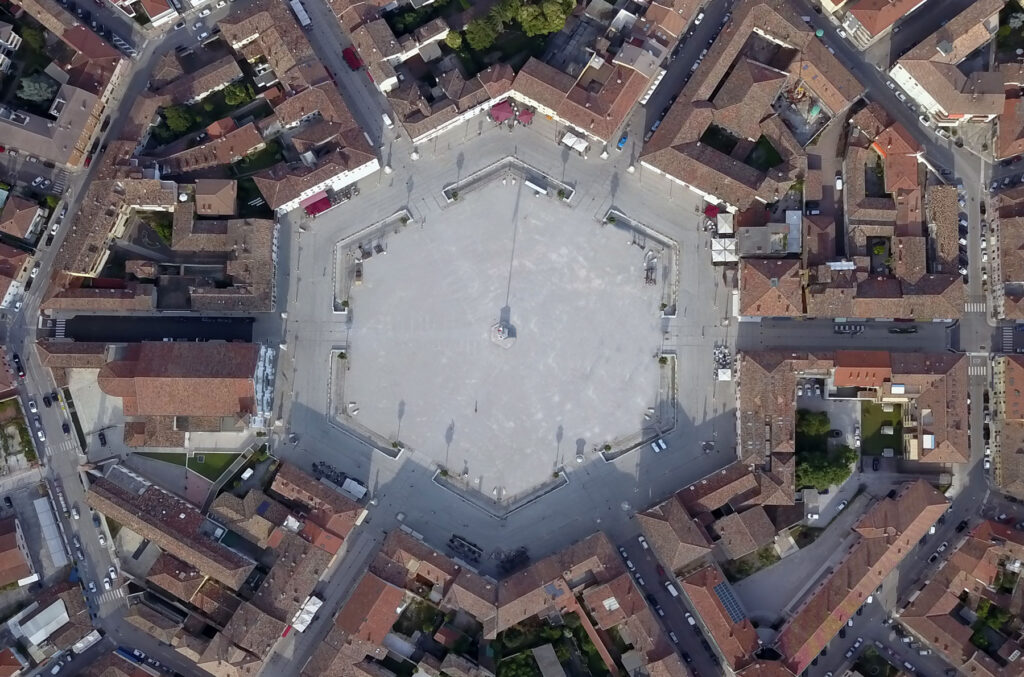
Main Square, the Banner and the Loggia della Gran Guardia
Piazza Grande is the soul of Palmanova: a perfect and surprising space where every street converges into a harmonious design unlike any other in the world. At its centre rises the Banner, symbol of the city, while elegant historic buildings, loggias and statues tell centuries of history. Between events, historical re-enactments and everyday life, this is where the authentic essence of a fortress that continues to live and enchant can still be felt. A place where art meets military engineering.
-
The Banner
At the centre of Piazza Grande stands a base made of Istrian stone with three well-heads, built in 1611 under the General Governor Giovanni Pasqualigo.
Rising above it is the Banner, a symbolic testimony to the history of the fortress of Palmanova: over the centuries the pole has flown the banner of Saint Mark, the French flag, the Habsburg eagle and finally the Italian tricolour.
The current mast, 28 metres high, was installed in 1893 to replace the previous wooden poles.
The Banner is also a symbol of the city and is affectionately called “Mario” by the people of Palmanova. -
Doge's Cathedral
Overlooking Piazza Grande, the Doge’s Cathedral is one of the most representative landmarks of Palmanova. Its façade in bright Istrian stone reflects the sunlight, symbolising the power of the Serenissima Republic of Venice. Inside, the intimate atmosphere preserves artworks and testimonies of the city’s history. A visit to the cathedral reveals the close connection between military function, urban planning and the religious dimension of the Fortress.
-
Palace of the Governor of Arms
The Palace of the Governor of Arms, located in Piazza Grande, was built in 1613 under the General Governor Benedetto Tagliapietra, to whom the plaque on the façade is dedicated.
It was the residence of the Governor of Arms, the third highest authority in the government of the fortress after the General Governor and the Treasurer. This military authority, appointed by the Venetian Senate, was responsible for overseeing the efficiency of all militias and weaponry, as well as ensuring the security of the fortress.
The palace features a three-storey façade with two arched gateways, one of which is surmounted by a window with a small balcony. -
Palace of Pawn Shop
The “Palazzo del Monte di Pietà” is located in Piazza Grande and was established in 1666 by the Extraordinary General Governor Alvise Molin following the expulsion of several Jewish moneylenders living within the fortress.
According to its regulations, the Pawn Shop was open on Tuesdays and Saturdays: pledges were accepted in the morning, while loans were distributed in the afternoon.
During the administration of General Governor Nicolò Dolfin, two new entrances were added, one facing Piazza Grande and the other Borgo Aquileia, in order to better preserve the privacy of visitors.
At the corner of the building stands a marble sculpture depicting the Pietà.
The institution remained active until 1978.
-
Columns with bronze statues
At the entrance to the Borgo Aquileia road axis stand two columns.
At their top are two sculptures whose original versions are now preserved in the Civic Historical Museum of Palmanova.
The sculpture depicting the Archangel Michael, dating from the late 16th century, is a clear allegory of divine justice.
The second figure, created in the 17th century, still raises several interpretative questions.
During Venetian rule, criminals of the fortress were executed between these two columns. -
Palace of the General Governor - Town Hall
The Palace of the General Governor (“Provveditore Generale”), now the Town Hall, was built by General Governor Marc’Antonio Memmo in 1598, as indicated by the date engraved on the keystone of the entrance portal.
It was later enlarged in 1611 by Giovanni Pasqualigo.
It served as the residence of the General Governor of the Patria del Friuli, appointed by the Doge of Venice for a term of 18 months.
During this period, the General Governor held full military and civil authority over Palmanova and the nearby villages of Palmada, Ronchis and San Lorenzo.
In addition to the apartments of the General Governor and his family, the palace also housed the Chancellery for the administration of justice.
Three wells ensured the water supply for the residence and service areas.
-
Priuli stele
In Piazza Grande stands the Priuli Stele, also known as the Pyramid of Virginity. This marble monument, set on a three-step base, was commissioned by Provveditore Alvise Priuli in 1654 to symbolise the inviolability of the fortress, which was never besieged by enemy forces.
-
Loggia della Gran Guardia and Merchants' Loggia
The Loggia della Gran Guardia, built between 1620 and 1625, is a seven-arched building located beside the Palace of the General Governor. Its name and strategic position derive from the fact that it served as headquarters for the militias, halberdiers and mounted guards entrusted with escorting and protecting the General Governor.
The adjacent structure, located at the corner with Contrada Savorgnan, is a raised three-arched loggia resulting from a 1924 renovation. Originally known as the Merchants’ Loggia, after the First World War it was dedicated to the Fallen Soldiers. Inside stands a commemorative monument by Marcello Mascherini. -
The 11 Statues of the General Governors
In Piazza Grande, visitors are welcomed by the statues of eleven of the General Governors who ruled the city of Palmanova.
This office, established from the foundation of the fortress, was considered one of the most prestigious positions in the Republic of Venice, as it could lead to the eventual appointment as Doge.
The exact identification of these statues remains uncertain.
In 1691, the inscriptions and coats of arms carved on their pedestals were erased following a law intended to prevent the cult of personality surrounding individual officials of the Republic.
The only inscription whose text is known today, thanks to a surviving family manuscript, is the one dedicated to General Governor Giovanni Sagredo.
-
Civic Historical Museum – Temporarily closed for renovation
The Civic Historical Museum is the ideal place to discover the history of Palmanova and the evolution of its fortification system. Housed inside Palazzo Trevisan, the museum preserves documents, maps, weapons, drawings and historical artefacts that tell the story of life under Venetian, Napoleonic and Austrian rule. From the foundation of the fortress to the present day, the storytelling exhibition reveals both the military engineering and the daily life behind this extraordinary UNESCO site. A must-see stop for anyone wishing to uncover what lies beneath the perfect geometry of the star-shaped city. Among the most fascinating objects on display is a 17th-century iron chest equipped with an ingenious and highly sophisticated locking mechanism.
-
Info Point
At the PromoTurismo FVG Tourist Infopoint, visitors can request information, plan their visit to Palmanova, and discover the city’s attractions and events. Here you can find maps, route information, details about exhibitions and cultural events, as well as practical advice to make the most of your time in the star-shaped fortress.
-
Austrian Prisons
In Via Scamozzi there are the buildings of the former court and the former Austrian prisons. The latter, in particular, used to be first a military prison and then a state prison.
After some time, they were renovated and now they have become a seat for cultural associations. -
FISCAL CHAMBER
In Borgo Udine stands the imposing “Palazzo del Ragionato” (or Treasury Chamber), which served as the residence of the Treasurer of the fortress under the Serenissima Republic of Venice.
The building was commissioned in 1598 by General Governor Marc’Antonio Memmo to house both the Treasurer’s residence and the Fiscal Chamber of the fortress of Palmanova.
The Treasurer’s duties included supervising all administrative and financial activities of the city, as well as managing payments for militias, workers and state officials operating within the fortress.
-
Gustavo Modena Theatre
The Gustavo Modena Theatre is one of the main cultural landmarks of Palmanova and a symbol of the city’s artistic and social life. Its elegant neoclassical façade welcomes visitors into a space dedicated to performances, events and cultural initiatives. Closely linked to the events of the Italian Risorgimento, the theatre combines history and culture, and still today remains an important point of reference for both the local community and visitors.
-
Church of Saint Francis of Assisi and the Sestiere Square
Located just a short walk from the city centre, the Church of Saint Francis of Assisi, built in 1603, is a small historical gem preserved within Piazza Garibaldi, the only surviving intact Sestiere square in Palmanova.
Its octagonal structure tells centuries of history marked by worship, military occupations and cultural restoration.
Inside, the harmony of the spaces invites visitors into an atmosphere of quiet reflection, revealing a story of faith deeply rooted in time.
Visiting the church means discovering both the religious soul and the historical memory of the star-shaped city.
-
The Napoleonic Powder Magazines of Garzoni and Foscarini
The two Napoleonic powder magazines in Contrada Garzoni and Contrada Foscarini were built at the beginning of the 19th century as ammunition depots.
Today, these atmospheric spaces, surrounded by the greenery of the bastions, have been transformed into venues for exhibitions and cultural events.
A unique opportunity to experience how military history has been turned into beauty within the heart of the UNESCO star-shaped city.
Characterised by imposing barrel vaults, ventilation slits and strong stone masonry walls, the powder magazines offer a remarkable insight into Napoleonic military engineering.
Visiting them reveals the perfect balance between their original defensive purpose and their new cultural role.
A third Napoleonic powder magazine also exists in Contrada Barbaro and is currently awaiting restoration and redevelopment.
-
Viewpoint of Cavaliere
From the “Belvedere del Cavaliere”, located between Porta Aquileia and Bastione Foscarini, it is possible to admire the entire fortification system designed first by Venetian engineers and later adapted by the Napoleonic military.
-
Porta Aquileia (or Porta Marittima) and the Countergate
Porta Aquileia, once known as Porta Marittima because it faced towards the Adriatic Sea, is a true architectural gem. Clad in elegant Istrian stone, it stands out for its refined appearance: during the Venetian period, it served as the ceremonial entrance reserved for distinguished guests and General Governors, becoming the fortress-city’s first grand impression. Inside the dongione (the upper section of the gate) visitors can now explore MAPE, the Museum of Bees and the Ecosystem of Palmanova, where history, nature and biodiversity come together.
-
Former Montezemolo Barracks – Temporarily closed for restoration
The former Montezemolo Barracks is an imposing historic building that tells centuries of military life in Palmanova.
Built at the end of the 16th century as a depot for ammunition and food supplies, it was expanded over the following decades and transformed into military barracks during the 19th century.
The complex is now set to become part of the “Recovery Art” project, supported by the European Union (PNRR funds) and the Italian Ministry of Culture.
It will host an art storage facility, restoration laboratories, research areas and exhibition spaces, becoming an important cultural hub for the entire north-eastern area of Italy.
-
Countermine Tunnels of the Ravelin and Donato Bastion
Descending into the Underground Countermine Tunnels means entering the secret spaces of Palmanova, where soldiers defended the fortress and lived hidden from enemy sight. Today, this underground route allows visitors to discover the ingenious defensive system of the fortress through passages, tunnels and underground chambers. A fascinating experience combining history, mystery and adventure, offering the chance to explore Palmanova from an unexpected perspective.
-
Austro-Hungarian Military Cemetery
The Austro-Hungarian Military Cemetery of Palmanova is a place of remembrance that invites reflection on the history of the twentieth century.
Here rest soldiers of different nationalities who served under the Austro-Hungarian Empire during the First World War.
Along the cypress-lined avenue, simple and orderly gravestones offer a silent and moving testimony to human sacrifice.
It is a peaceful and contemplative place, where the surrounding landscape accompanies remembrance and allows visitors to approach the human and historical events connected to the conflict with respect and reflection.
-
Church of Saints Lorenzo and Sebastian – Sottoselva hamlet
A short distance from the fortress, the Church of Saints Lorenzo and Sebastian welcomes visitors in the village of Sottoselva.
It tells the story of the area and its transformations over time.
Born from the union of two religious communities, it preserves elements from different historical periods, such as an ancient 16th-century holy water stoup.
This sacred building, a custodian of rural faith, stands out for its harmonious simplicity.
A modest and authentic place where history, faith and local tradition blend within a quiet and intimate setting.
Where to inform you and where to find us
Contacts
PromoTurismo FVG Tourist Infopoint
Borgo Udine, 4 33057 Palmanova UD
How to get there
Palmanova center
Piazza Grande
33057
Palmanova UD, Italia