

Porta Aquileia (or Porta Marittima) and the Countergate

One of the three monumental gateways to the star-shaped fortress, a majestic entrance into Palmanova’s Venetian history
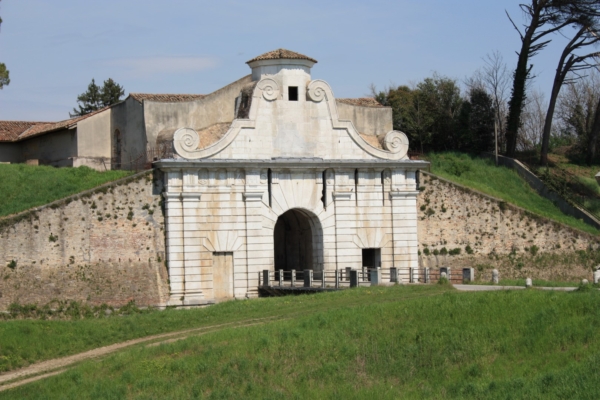
Porta Aquileia: pale stone façade with a central arch beside the grassy ramparts.

Tourist introduction

Porta Aquileia, once known as Porta Marittima because it faced towards the Adriatic Sea, is a true architectural gem. Clad in elegant Istrian stone, it stands out for its refined appearance: during the Venetian period, it served as the ceremonial entrance reserved for distinguished guests and General Governors, becoming the fortress-city’s first grand impression. Inside the dongione (the upper section of the gate) visitors can now explore MAPE, the Museum of Bees and the Ecosystem of Palmanova, where history, nature and biodiversity come together.

Historical facts

PORTA AQUILEIA OR PORTA MARITTIMA
Porta Aquileia, once also called Porta Marittima because it faced the Adriatic Sea, was the first of Palmanova’s three gates to be built, in 1598.
The structure is externally clad in Istrian stone and differs from the other two entrances to the city through its greater elegance, as during the time of the Serenissima Republic it served as the ceremonial entrance for distinguished guests and the General Governors.
The façade of Porta Aquileia is embellished with two large volutes embracing the guard turret. Particularly valuable are also the refined friezes and Baroque decorative elements. Beneath the guard turret, on the cornice, once stood a large stone Lion of Saint Mark, later chiselled away by the French in 1797.

COUNTERGATE
Originally, access to the fortress followed a route that curved around the rivellini protecting the city gates.
The defensive earthwork, now cut through by the modern access road, was controlled on both sides by two countergates connected directly to the defensive walls.
Following the path around the rivellino and passing through the countergate, visitors reached a wooden bridge used to cross the first section of the moat, before arriving at the monumental gate itself, protected in turn by a drawbridge operated by powerful wheels moved from inside the fortress.
Today, only two countergates remain visible: one outside Porta Cividale and the other outside Porta Aquileia.

MUSEUM OF BEES AND THE ECOSYSTEM OF PALMANOVA – MAPE
MAPE is an experiential museum space dedicated to discovering the world of bees and their fundamental role in the environment. Through educational routes, observation activities and interactive experiences, both adults and children can learn about the life of the hive, honey production and the importance of pollinating insects. Set within the unique surroundings of Palmanova’s bastions, the museum combines education, biodiversity and the promotion of the local area.

Opening hours

The exterior can be accessible without time restrictions.
The interior dongione (upper section of the gate) is open only during special openings or events

Admission

Free entry

Accessibility

Externally accessible for visitors with motor disabilities, visitors with sensory disabilities accompanied by an assistant, and visitors with intellectual and psychological disabilities.

The interior dongione is not accessible for visitors with motor disabilities.

Where to inform you and where to find us

Contacts

PromoTurismo FVG Tourist Infopoint

Borgo Udine, 4 33057 Palmanova UD

Tel. +39 0432 924815

info.palmanova@promoturismo.fvg.it

How to get there

Palmanova center

Piazza Grande
33057
Palmanova UD, Italia

Find out how to get to Palmanova