

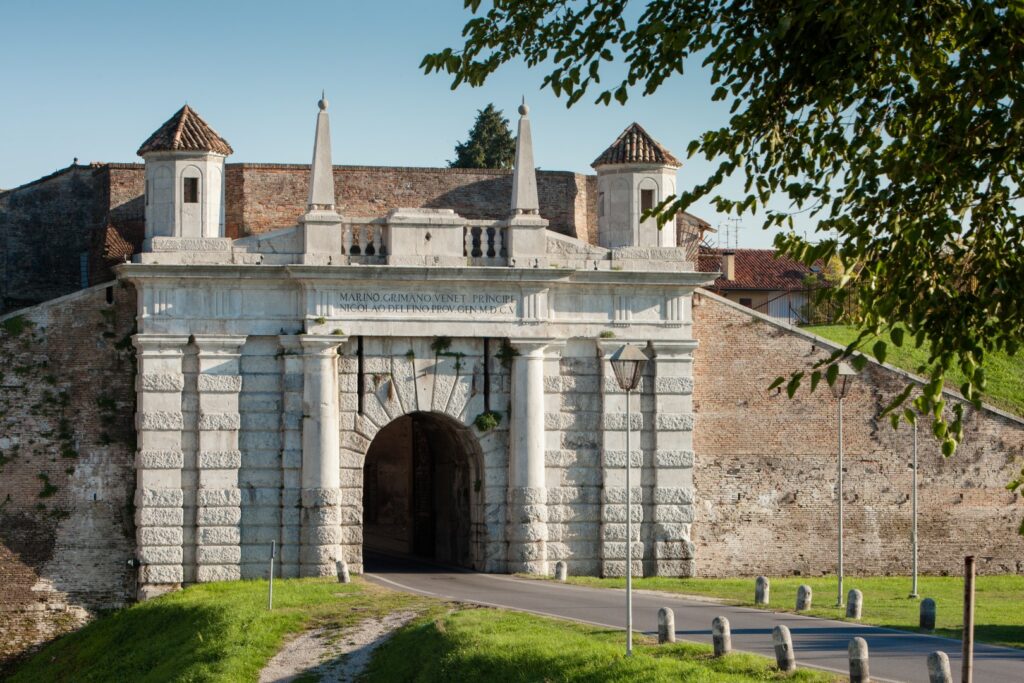
Three monumental entrances to the star-shaped city, a majestic gateway to Palmanova’s Venetian history.
The north-western access to the Fortress, a majestic monumental entrance leading into Palmanova.
Step through the monumental Porta Cividale, the timeless threshold of the star-shaped city.
Tourist introduction
Porta Udine
Porta Udine, one of the three historic gateways into the fortress city, welcomes visitors arriving from the heart of Friuli. Its imposing façade, with half-columns, spires and sentry boxes, still preserves the original drawbridge wheels and the garrison quarters. Outside, the Venetian aqueduct and the small waterfalls of the Roggia di Palma tell a story of history, engineering and nature, offering an evocative route among monuments and views.
Porta Cividale and counter-gate
Porta Cividale greets visitors with its austere stone rustication. A true gem of military architecture, the gate was not merely an entrance but an insurmountable defensive structure. Today it houses the Museum of the Great War and of the Fortress of Palmanova, offering a privileged view of the imposing fortifications. Walking through its wide vaults is a leap back in time, among echoes of soldiers and the indelible mark of Venetian genius.
Porta Aquileia (or Porta Marittima) and counter-gate
Porta Aquileia, once known as Porta Marittima (the Sea Gate) because it faced the Adriatic, is a true architectural gem. Clad in elegant Istrian stone, it stands out for its refinement: in Venetian times it was the ceremonial entrance reserved for distinguished guests and the Provveditori Generali (the Venetian governors-general), the fortress city’s first calling card. Inside, in the Dongione, it now houses MAPE – the Palmanova Museum of Bees and the Ecosystem, where history, nature and biodiversity meet.
Historical facts
PORTA UDINE
Porta Udine, one of the three possible entrances to the fortress city, takes its name from the destination it leads to. Built between 1604 and 1605, it still preserves the two large wheels used to raise and lower the drawbridge.
The monumental façade features two side half-columns and, above the cornice, two spires and two sentry boxes.
Inside is a courtyard with two porticoes fitted with fireplaces and rooms that housed the garrison troops on guard duty.
Outside the gate, the large white-stone aqueduct can be seen.
VENETIAN AQUEDUCT
Outside Porta Udine stands the massive structure of the Venetian Aqueduct, whose construction dates back to the origins of the fortress. It was restored several times: in 1665, for example, Provveditore Alvise Molin had it almost entirely rebuilt using stone from Medea; remodelled in 1751 in the neoclassical style, it only took on its present form in 1771. The aqueduct carried water from the Roggia di Palma into the fortress for civic use. The central plaque, made in 1751 by Carlo Pico, a native of Palma, depicts a lion skin between two allegorical female figures: Hygieia and the Spring. It also bears an inscription praising Provveditore Pisani; in 2013 it was fully restored by the Soprintendenza (the state heritage authority).
ROGGIA DI PALMA AND THE SMALL WATERFALLS
The water feeding the Venetian aqueduct comes from the Roggia di Palma, a canal that branches off the Torre stream at the rocky narrows of Zompitta, north of Udine.
Already mentioned in documents in 1171, the canal is the oldest historically documented water diversion in Friuli.
After a course of about 32 kilometres, shaped by the works of the Serenissima (the Republic of Venice), the watercourse reaches this final point, where it flows into the fortress’s seventeenth-century moat.
About 3 metres high, this small waterfall was restored in 2015, together with the short channel that Venetian craftsmen had built in brick, with a bed of dry-laid stones.
PORTA CIVIDALE
Built between 1604 and 1605 under Provveditore Generale Nicolò Dolfin, it is one of the three entrances to the fortress of Palmanova. Its monumental, austere façade has no decoration but is clad in white and grey stone worked in rustic ashlar. Its guard towers, linked by a balustrade, give it a stern appearance. The highest part of the gate, the Dongione, houses the Museum of the Great War and of the Fortress of Palmanova, which holds documents, weapons, uniforms and memorabilia spanning the city’s entire history, from its foundation in 1593 to the present day. More than 400 years of history of the armies that lived and served in the fortress city are preserved here.
COUNTER-GATES
Originally, the fortress was reached along a path that skirted the ravelins defending the gates.
The defensive earthwork, now cut through by the road into the city, was guarded on either side by two counter-gates that formed a single whole with the city walls.
Following the path around the ravelin and passing through the counter-gate, one came to a wooden bridge over the first stretch of the moat, and then to the monumental gate, itself protected by a drawbridge operated by powerful wheels turned from inside.
Two can still be seen today: one outside Porta Cividale and the other outside Porta Aquileia.
PORTA AQUILEIA OR MARITTIMA
Porta Aquileia, once also called Porta Marittima because it faces the Adriatic, was the first of Palmanova’s three gates to be built, in 1598.
Its exterior is clad in Istrian stone, and it is more elegant than the other two entrances because, in the days of the Most Serene Republic of Venice, it was the ceremonial entrance for distinguished guests and the Provveditori Generali.
The façade of Porta Aquileia is graced by two wide volutes framing the sentry box. The refined friezes and baroque elements that decorate it are also of great value. Beneath the sentry box, on the cornice, once stood a large stone Lion of St Mark, chiselled away by the French in 1797.
COUNTER-GATE
Originally, the fortress was reached along a path that skirted the ravelins defending the gates.
The defensive earthwork, now cut through by the road into the city, was guarded on either side by two counter-gates that formed a single whole with the city walls.
Following the path around the ravelin and passing through the counter-gate, one came to a wooden bridge over the first stretch of the moat, and then to the monumental gate, itself protected by a drawbridge operated by powerful wheels turned from inside.
Today only two counter-gates remain visible: one outside Porta Cividale and the other outside Porta Aquileia.
MAPE – PALMANOVA MUSEUM OF BEES AND THE ECOSYSTEM
MAPE is an experiential space devoted to discovering the world of bees and their vital role in the environment. Through educational trails, observation and interactive activities, it lets visitors young and old take a close look at life in the hive, honey production and the importance of pollinating insects. Set within the unique surroundings of Palmanova’s bastions, it combines education, biodiversity and the promotion of the local area.
Opening hours
The exterior can be visited at any time. The interior (the Dongione, the upper part of the gate) is open during special openings or events.
Location
Accessibility
Externally accessible for visitors with motor disabilities, visitors with sensory disabilities accompanied by an assistant, and visitors with intellectual and psychological disabilities.
The interior dongione is not accessible for visitors with motor disabilities.
Where to inform you and where to find us
Contacts
PromoTurismo FVG Tourist Infopoint
Borgo Udine, 4 33057 Palmanova UD
How to get there
Palmanova center
Piazza Grande
33057
Palmanova UD, Italia