

Porta Udine

The north-western gateway to the fortress, a majestic monumental entrance into Palmanova.
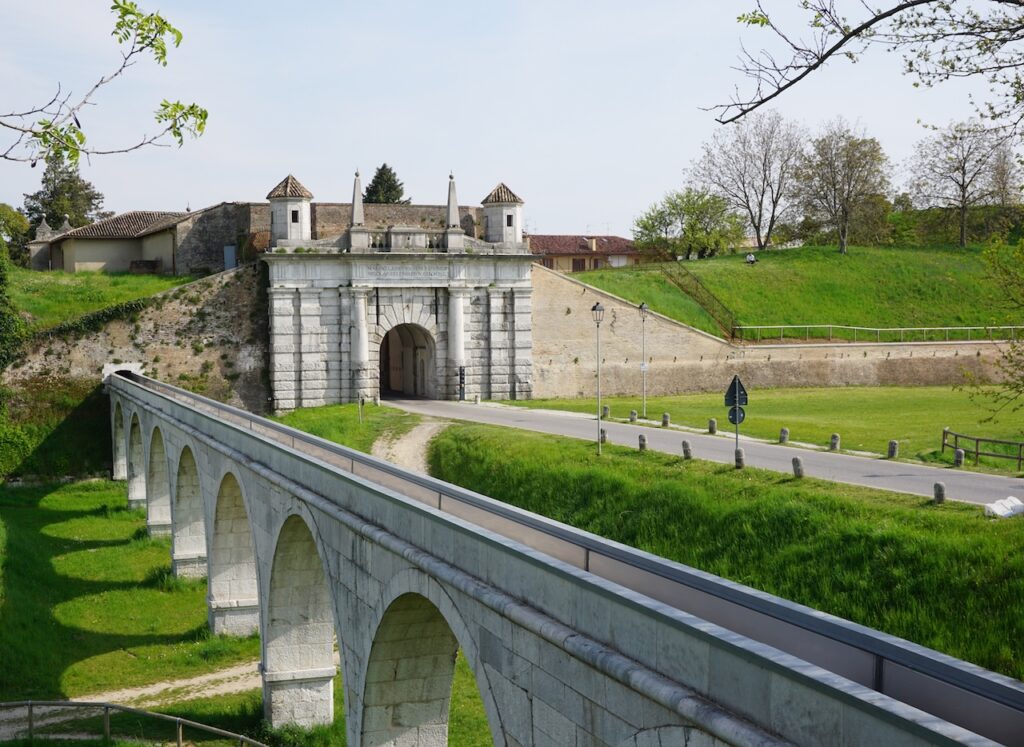
Porta Udine - Municipality of Palmanova

Tourist introduction

Porta Udine, one of the three historic gateways to the fortress-city, welcomes visitors arriving from the heart of Friuli. Its imposing façade, enriched with semi-columns, spires and guard turrets, still preserves the original mechanisms of the drawbridge wheels as well as the former soldiers’ quarters. Outside the gate, the Venetian aqueduct and the cascades of the Roggia di Palma tell a story of engineering, water management and landscape, offering a striking journey through monuments and natural scenery.

Historical facts

PORTA UDINE
Porta Udine, one of the three access points to the fortress-city, takes its name from the direction it faces. Built between 1604 and 1605, it still preserves the two large wheels used to raise and lower the drawbridge.
The monumental façade features two lateral semi-columns, and above the cornice stand two spires and two guard turrets.
Inside, the gate opens onto a courtyard with two arcaded wings, equipped with fireplaces and rooms used as accommodation for the garrison responsible for guarding the entrance.
Outside the gate stands the large white stone aqueduct.

VENETIAN AQUEDUCT
Outside Porta Udine rises the imposing structure of the Venetian Aqueduct, whose construction dates back to the origins of the fortress.
It was restored several times: in 1665, for example, General Governor Alvise Molin had it almost completely rebuilt using stone from Medea; rebuilt again in 1751 in a neoclassical style, it finally took its current form in 1771.
The aqueduct was used to bring water from the Roggia di Palma into the fortress for civic use.
The central plaque, created in 1751 by the Palmarian sculptor Carlo Pico, depicts a lion skin flanked by two female allegorical figures: Hygieia and the Spring. It also bears a laudatory inscription dedicated to General Governor Pisani; in 2013 it was fully restored by the Superintendency.

ROGGIA DI PALMA AND WATERFALLS
The water feeding the Venetian aqueduct comes from the Roggia di Palma, which originates from the Torre stream near the narrow gorge of Zompitta, north of Udine.
The roggia, already mentioned in documents from 1171, is the oldest historically recorded artificial water channel in Friuli.
After a course of about 32 kilometres, following interventions by the Serenissima Republic of Venice, the water reaches this final point and flows into the 17th-century fortress moat.
About three metres high, this small waterfall was restored in 2015, together with the short channel built by Venetian engineers using brickwork and a dry-stone pebble bed.

Opening hours

Visitabile esternamente senza limitazioni di orario.

Admission

Free entry

Accessibility

Externally accessible for people with mobility, sensory (with an escort/companion), intellectual, and mental disabilities.

Where to inform you and where to find us

Contacts

PromoTurismo FVG Tourist Infopoint

Borgo Udine, 4 33057 Palmanova UD

Tel. +39 0432 924815

info.palmanova@promoturismo.fvg.it

How to get there

Palmanova center

Piazza Grande
33057
Palmanova UD, Italia

Find out how to get to Palmanova