

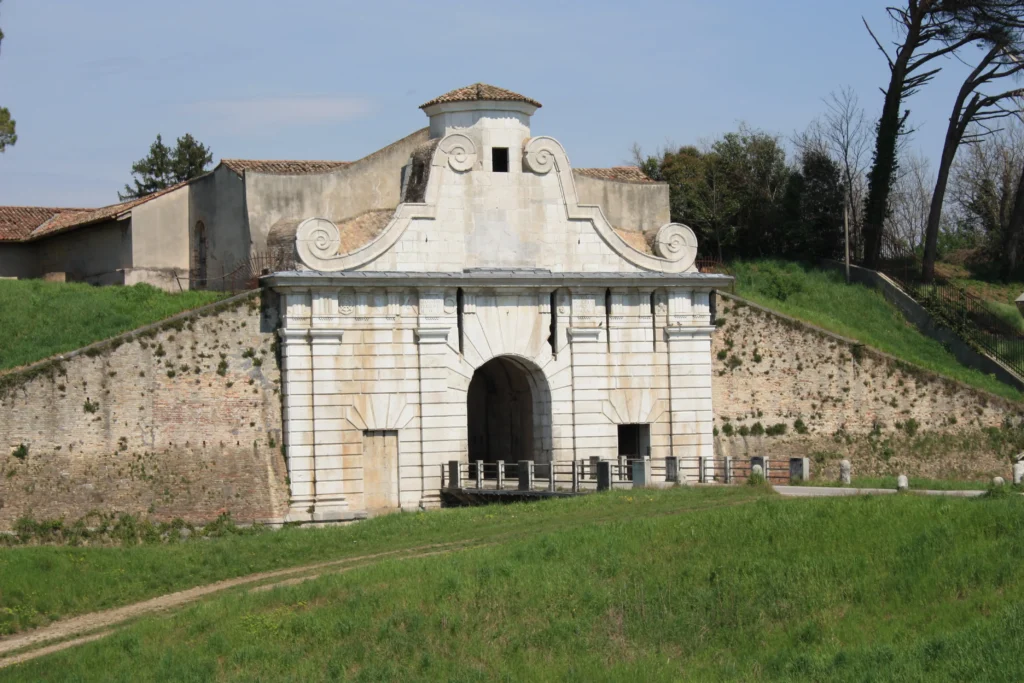
Porta Aquileia, once known as Porta Marittima because it faced towards the Adriatic Sea, is a true architectural gem. Clad in elegant Istrian stone, it stands out for its refined appearance: during the Venetian period, it served as the ceremonial entrance reserved for distinguished guests and General Governors, becoming the fortress-city’s first grand impression. Inside the dongione (the upper section of the gate) visitors can now explore MAPE, the Museum of Bees and the Ecosystem of Palmanova, where history, nature and biodiversity come together.
Fortifications Ring
Discover the three souls of the fortress: history, nature and sport.
The Fortifications Ring follows the route surrounding the entire star-shaped city. This circular itinerary winds through bastions, moats and monumental gates, offering a unique overall view of the defensive system.
The route crosses different environments, each with its own identity: areas dedicated to historical exploration, with access to underground galleries and military structures; natural spaces where the biodiversity of meadows and moats creates a rich and surprising ecosystem; and open-air areas ideal for sports and outdoor activities, to be enjoyed on foot, by bicycle or on horseback.
Walking along the ring allows visitors to discover a Palmanova in constant balance between past and present, where military engineering intertwines with the landscape and with new ways of experiencing the city.
Itinerary - Places to visit
-
-
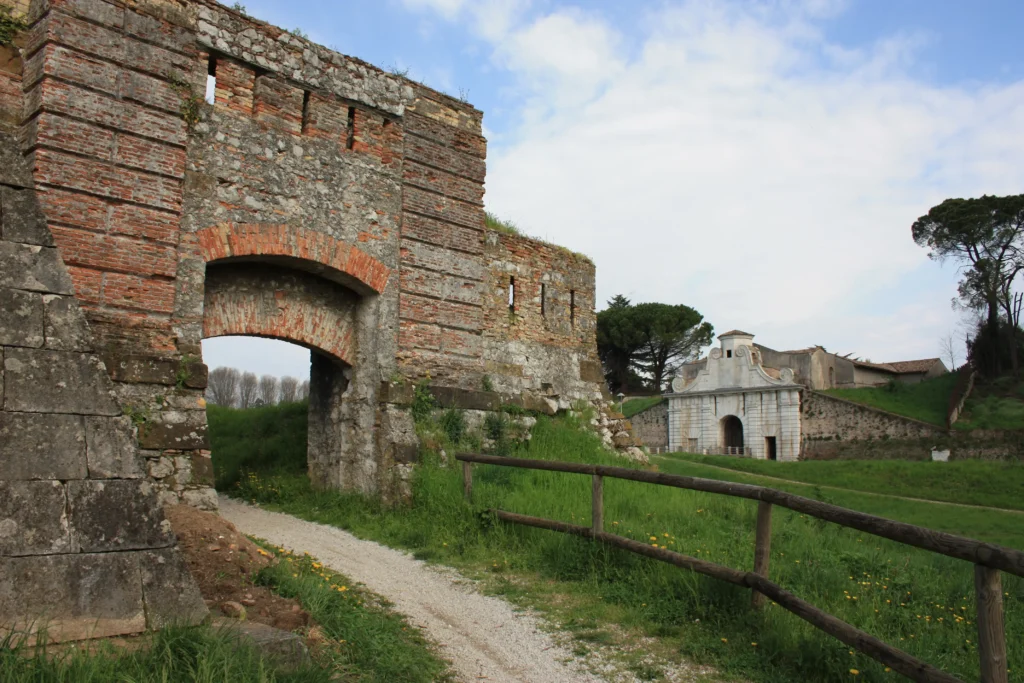
Countergates
Originally, access to the fortress followed a route that bypassed the rivellini protecting the gates.
The defensive earthwork, now cut through by the access road to the city, was controlled on both sides by two countergates, which formed an integral part of the defensive wall system.
Following the path around the rivellino and passing through the countergate, visitors would reach a wooden bridge used to cross the first section of the moat, and then arrive at the monumental gate itself, protected in turn by a drawbridge operated by powerful internal mechanisms.
Today, two countergates are still visible: one outside Porta Cividale and the other outside Porta Aquileia. -
Palmanova bastions
The bastions of Palmanova are a masterpiece of military engineering and a testament to Venice’s once-impenetrable defensive system. These colossal earthworks draw the iconic nine-pointed star shape, today a green oasis ideal for walking and trekking through history. Along the ramparts, visitors encounter guard lodges, powder magazines and panoramic viewpoints offering breathtaking views over the city, the moat and the Roggia di Palma. A journey through history, military architecture and nature, where every corner reveals the brilliance of Venetian and Napoleonic defensive design.
-
Moat
The moat surrounds the entire fortress for about 4 kilometres, between the first and second ring of walls.
Originally a dry moat, it was used to drain unhealthy water from the city.
Later fed by the Roggia di Palma, it became an additional defensive barrier preventing enemy approach.
This highly complex engineering work, with its mechanical systems and level differences, still allows water flow today and represents an important micro-habitat for many species of flora and fauna.
-
Viewpoint of the willows
Located between Bastione Villachiara and the south-eastern Rivellino, this viewpoint (“Belvedere dei Salici”) offers a privileged observation point over the defensive system, providing a full view of bastions, moat and Roggia di Palma between the first and second defensive rings.
-
Napoleonic Lunettes
The Napoleonic Lunettes represent the third defensive ring of Palmanova, added in the early 19th century by order of Napoleon Bonaparte.
These triangular earthworks, surrounded by greenery, reflect the military engineering of the nineteenth century and today offer a fascinating route through fortifications and landscape.
Walking among caponiers and casemates, visitors discover an environment where history and nature intertwine.
Now transformed into evocative green pathways, they are ideal for walking and cycling between history and nature.
Exploring them means immersing oneself in historic military engineering while enjoying the silence surrounding this extraordinary UNESCO heritage site.
-
Porta Udine
Porta Udine, one of the three access points to the fortress-city, takes its name from the direction it faces.
Built between 1604 and 1605, it still preserves the two large wheels used to raise and lower the drawbridge.
The monumental façade features two lateral semi-columns, and above the cornice stand two spires and two guard turrets.
Inside, the gate opens onto a courtyard with two arcaded wings, equipped with fireplaces and rooms used as accommodation for the garrison responsible for guarding the entrance.
Outside the gate stands the large white stone aqueduct.
-
Roggia di Palma and waterfalls
The water feeding the Venetian aqueduct comes from the Roggia di Palma, which originates from the Torre stream near the narrow gorge of Zompitta, north of Udine.
The roggia, already mentioned in documents from 1171, is the oldest historically recorded artificial water channel in Friuli.
After a course of about 32 kilometres, following interventions by the Serenissima Republic of Venice, the water reaches this final point and flows into the 17th-century fortress moat.
About three metres high, this small waterfall was restored in 2015, together with the short channel built by Venetian engineers using brickwork and a dry-stone pebble bed. -
Countermine Tunnels of the Ravelin and Donato Bastion
Descending into the Underground Countermine Tunnels means entering the secret spaces of Palmanova, where soldiers defended the fortress and lived hidden from enemy sight. Today, this underground route allows visitors to discover the ingenious defensive system of the fortress through passages, tunnels and underground chambers. A fascinating experience combining history, mystery and adventure, offering the chance to explore Palmanova from an unexpected perspective.
-
Bastion with sortie lodge
At the corners of the bastion, known as “ears” (“orecchioni”), there were two soldiers’ lodges.
The one on the left included a sortie ramp leading directly outside the fortress.
The one on the right was used as a guard and shelter room for troops and was equipped with a fireplace and several niches for lighting. Today, this space is occasionally used for historical reenactments. -
Porta Cividale
Porta Cividale welcomes visitors with its austere rusticated stone façade. A true masterpiece of military architecture, the gate was not merely an entrance but an impregnable defensive structure. Today it hosts the Museum of the Great War and of the Fortress of Palmanova, offering a privileged view over the imposing fortifications. Passing through its wide vaulted halls means taking a journey back in time, amid echoes of soldiers and the enduring mark of Venetian engineering genius.
Where to inform you and where to find us
Contacts
PromoTurismo FVG Tourist Infopoint
Borgo Udine, 4 33057 Palmanova UD
How to get there
Palmanova center
Piazza Grande
33057
Palmanova UD, Italia